
“Silence… Did They Know?” : Sexual and Gender-Based Violence and Harassment (SGBVH) in Cinema and Audiovisual
Maison du Barreau – 28 May 2026
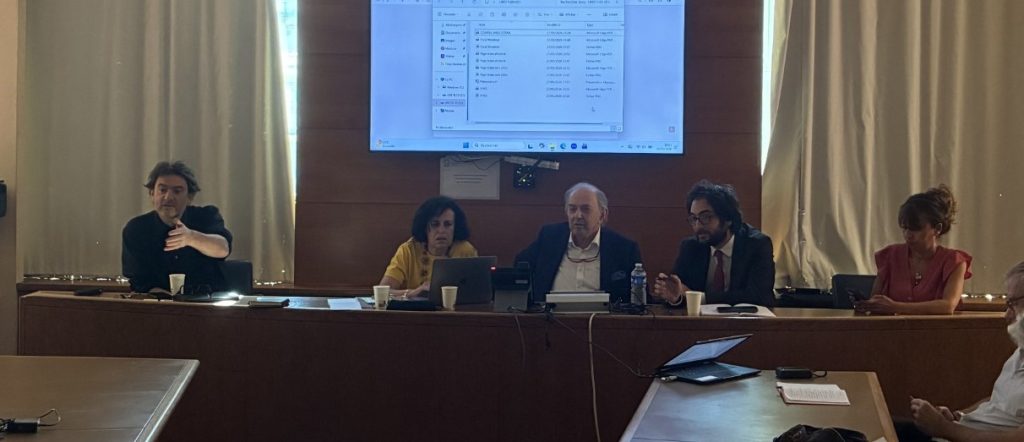
Organised by COMINA (Open Commission for Digital Innovation in Audiovisual at the Paris Bar), this morning of legal reflection on sexual and gender-based violence and harassment (SGBVH) in cinema and audiovisual aimed to address a particularly sensitive subject without activism, without oversimplification, and without moral posturing.
Gathered around Gérald Bigle, moderator of the event, were:
- Erwan Balanant, Member of Parliament and rapporteur of the parliamentary inquiry commission on SGBVH in the cultural sector;
- Valérie Lépine-Karnik, former Secretary General of the UPC and mediator;
- Dylan Slama, criminal lawyer;
- Monia Ait El Hadj, intimacy coordinator;
- Didier Carton, former delegate of the CCHSCT for audiovisual production and specialist in occupational risk prevention.
Numerous spontaneous contributions from producers, lawyers and professionals in the sector also enriched the discussion, in keeping with the “think tank” format characteristic of COMINA.
From Silence To Legal Proceedings
In his opening remarks, Gérald Bigle recalled how cultural representations of relations between men and women had evolved profoundly. Behaviours that were once normalised, romanticised or ridiculed are today re-read through the lens of consent, coercion, domination, harassment and legal responsibility.
Many films from the 1950s to the 1980s depict behaviours that, placed in a contemporary context, would raise serious questions today:
- the “passionate” slap,
- the “stolen kiss”,
- persistent flirting,
- or certain scenes in which a woman’s refusal eventually yields under male insistence.
Since #MeToo, the social gaze has shifted. And with it, the legal gaze. What once fell within the realm of the unspoken, of implicit customs or “that’s just how it works,” now tends to be: named, regulated, reported, prevented, and sometimes brought before the courts.
A Systemic Awakening
Erwan Balanant revisited the work of the parliamentary inquiry commission, which highlighted the systemic nature of SGBVH in the cultural sector. More than 200 hours of hearings notably revealed:
- the frequency of situations involving domination or assault;
- the difficulty victims face in speaking out;
- but also a profound lack of awareness of labour law within the audiovisual sector.
According to several participants, this ignorance of employers’ obligations to prevent harm and protect employees has long enabled abusive behaviour to take hold.
THE PRODUCER AT THE HEART OF THE SYSTEM
Discussion focused extensively on the role of the producer, who is legally both employer and responsible for the safety of their teams. Valérie Lépine-Karnik outlined the measures progressively put in place since 2019 under the impetus of professional organisations and the CNC:
- mandatory SGBVH training;
- conditioning of CNC funding;
- reporting units;
- SGBVH designated officers;
- specific clauses in collective agreements;
- protocols relating to intimacy scenes;
- enhanced protection for minors.
The CNC thus deployed a particularly effective economic lever: without mandatory training, access to public funding is denied. Participants also noted that the employer’s liability extends well beyond the strict confines of the film set and encompasses the full professional lives of the teams: accommodation, social events, travel, and situations of proximity inherent to filming.
NEW PROFESSIONS EMERGE
Didier Carton outlined the role of SGBVH designated officers, tasked with providing a listening and alerting function on set. He nonetheless highlighted the practical limitations of the system: power dynamics on set, the precarious employment status of workers, and the difficulty of raising an alert when the producer themselves is the person implicated.
Monia Ait El Hadj presented the role of the intimacy coordinator, now an increasingly common presence on productions. Their role includes:
- preparing sensitive scenes;
- clarifying the limits of performers;
- choreographing physical interactions;
- and ensuring respect for the consent expressed by actors.
The precise contractualisation of intimacy scenes is today becoming a professional standard.
LABOUR LAW, CRIMINAL LAW AND TRIAL BY MEDIA
One of the richest moments of the debate concerned the tensions between: the protection of victims, the presumption of innocence, internal investigations, disciplinary procedures, and trial by media.
Dylan Slama expressed his concern about a “post-judicial era” in which certain reputations can be destroyed before any court decision is reached. In his view, some internal procedures risk circumventing the fundamental guarantees of criminal law: presumption of innocence, the adversarial principle, statutes of limitation, or the rights of the defence.
Other participants noted that employers’ obligations to protect employees exist independently of criminal proceedings and may justify precautionary measures designed to safeguard staff. The discussions also highlighted: the slowness of judicial proceedings, the difficulty of establishing proof, cases being dropped, and growing tensions between judicial truth, factual truth and public reputation.
LEGISLATIVE PERSPECTIVES
Erwan Balanant presented several avenues drawn from the recently filed bill:
- strengthening prevention obligations;
- the generalisation of internal investigations;
- integrity checks for individuals working with minors;
- enhanced protection for young performers;
- stronger regulation of intimacy scenes;
- insurance mechanisms for filming interruptions related to SGBVH.
These proposals prompted lively exchanges on their practical and economic consequences for French productions.
CONCLUSION
This morning was not intended to produce a consensus. Its ambition was to bring into dialogue: lawyers, a parliamentarian, cinema practitioners, advocates for victims, and advocates for the accused.
The debate at times revealed tensions, disagreements and profound concerns. But above all, it demonstrated that it is still possible, even on particularly sensitive subjects, to debate freely, in an adversarial and serene manner, without caricature or oversimplification.
All participants ultimately shared the same observation: human relations in the world of cinema and audiovisual have entered a phase of profound transformation. What once fell within the domain of implicit customs, silence or invisible power dynamics now tends to be: named, regulated, prevented, reported, and sometimes brought before the courts.
This shift today extends well beyond the world of cinema. It speaks more broadly to the contemporary evolution of our social, professional… and human relationships.
The richness of the exchanges, the diversity of perspectives represented and the quality of the debate confirmed the value of this kind of cross-disciplinary reflection, at the intersection of law, artistic creation, individual freedoms and new societal expectations.
COMINA will naturally continue this commitment to free and pluralistic reflection on the major legal and human transformations currently reshaping the world of cinema and audiovisual.